

Women in Iraq: Illusions, confusions, and coverup
Redstockings posted this documentary as the Bush administration was shifting the pretext for having invaded Iraq from "weapons of mass destruction" (not there) to "liberating Iraqi women." As the following images and quotes reveal, at the time of the U.S. invasion Iraq was one of the most progressive countries for women in the region, far more progressive than U.S. allies Saudi Arabia and Kuwait.
In the invasion's aftermath, equality between men and women has decreased, not advanced. As reported by Women for Women International, on top of the carnage of war and the ensuing disruption of basic services like clean water, electricity and medical care, Iraqi women are now plagued by the rise of conservative Islamists (Code Pink, 4/9/08)
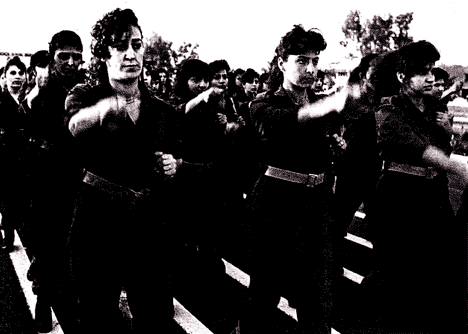
Iraqi women military volunteers pictured in Time Magazine, November 12, 1990 with the caption "In Baghdad, volunteers for the popular army are marching as if to war." Nicholas Kristof, in the New York Times, notes "Iraqi women routinely boss men and serve in non-combat positions in the army." New York Times October 1st, 2002 "Iraq's Little Secret" Photo: Luigi Baldelli--Contrasto/Saba.
AMERICANS MISINFORMED ABOUT IRAQI WOMEN
WHICH IS MORE ACCURATE?
"Saddam Hussein lives in a world in which women's liberation is a contradiction in terms, in which a woman with her sleeves rolled up is considered a rebuke to her creator. …Perhaps this will inspire him to treat any female prisoners like pack animals. Or perhaps the paternalistic attitudes of the Muslim world will lead him to tread more carefully…"
Anna Quindlen, on the possible treatment of female U.S. Prisoners of War in Iraq during the Gulf War of 1991. "Women Warriors" New York Times, Feb. 3, 1991, p. E19
"They [opponents of the U.S. occupation] know this is a war over ideas and values and governance. They know this war is about Western powers, helped by the U.N., coming into the heart of their world to promote more decent, open, tolerant, woman-friendly, pluralistic governments by starting with Iraq..."
Thomas L. Friedman, "Fighting 'The Big One'" New York Times, August 24, 2003, p. wk11
"[The town meeting with U.S. Representative Cliff Stearns (R)] included a Power Point presentation on the Iraq war. This fascinating presentation included the statement that part of the intent of the invasion was to improve the status of women's rights in that country."
Fay Baird, "Meeting not just a pep rally," Gainesville (FL) Sun, May 14, 2003
"...The Iraq constitution mandates equality between sexes, races, languages, social backgrounds and religions. It calls for equal pay for equal work, work benefits, and advancement opportunities. Iraqi women have the right to vote. They vote in somewhat equal percentages as men (46%).
"Women have the right to own land and control their personal finances. They have the right to divorce in civil courts. The literacy rate for women and men is 89%. Women make up 70% of all pharmacists, 46% of all dentists, 29% of all doctors, and 27% of the industrial work force.
"...Women are entitled to the identical inheritance of men. Child care centers are fully paid by the government, and women have 6 months paid maternity leave. Contraception is legal and available. Abortion is not legal. There are 38 women in the National Assembly, made up of 250 members. Iraq has a strong and well-organized feminist movement. With the destruction of Iraq it is likely that women will lose much of what they fought so long to gain.
("NOW critical of Bush's Middle East Meddling" by Beth Corbin, Jennifer Goldberg and Sarah Springer, National Organization for Women, National NOW Times, March/April 1991, pp. 1ff.)
Status of Iraqi women compared to other Gulf States
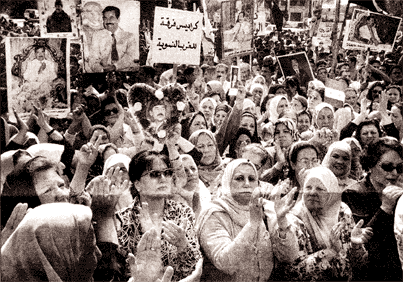
In Iraq there is no law that women cover their heads or faces, in contrast to other Gulf states like Saudi Arabia, and in contrast to Afghanistan under the Taliban. Here women with and without headscarves attend a pro-Saddam Hussein election rally, October 16, 2002. Photo: Associated Press
Iraqi women won the right to vote and were first elected to congress in 1980. Women are not allowed to vote or be elected in Saudi Arabia, Kuwait, Brunei, Qatar or Oman. (UN Development Program, 1999, p. 238.) Many of these U.S. allies hold no elections at all. Bahrain held its last election in 1973. (UN, 1995, p. 217-219.)
In 1987, 13% of the seats in congress in Iraq were filled by women, in 1994 11% were. To compare, Saudi Arabia, UAE, Qatar and Kuwait had no women in any ministerial or representative capacity. Iran had 4% and Turkey had 2% women in parliament, Jordan had 6%, Israel had 9%, Pakistan had 2% and the U.S. had 5%.(UN, 1995, p. 174.)
Like most countries around the world, nearly all Gulf states have provisions for paid maternity leave. Iraq provides 62 days of maternity leave, with the woman's wages paid 100% by the Social Security system. (By contrast, the U.S. law provides 12 weeks unpaid sick leave, but only if your employer has over 50 employees and only if you have been working for the same employer for over a year. There are only a handful of countries in the world that still provide no paid parental leave , the U.S. among them.)
However, Iraq has more women in the paid workforce than many other Gulf states. In 1994, Iraq recorded that 22% of paid workforce participation was by women. For comparison, paid workforce participation by women was 7% in Saudi Arabia, 11% in Jordan, 18% in Syria, 7% in Qatar, 9% in UAE, and 23% in Kuwait. It was 33% in Israel and 42% in the U.S. for that year. (UN, 1995, p. 144.)
Iraq also has significant female participation in managerial and administrative positions. For example, in 1990 women in Iraq filled 22% of the teaching positions at universities, and filled 13% of administrative and managerial jobs. In other Gulf states the picture is dimmer. For managerial and professional jobs, less than 1% of these were held by women in Saudi Arabia, 1% held such positions in Qatar, 2% in such positions in UAE, 5% in Kuwait, and 8% in Bahrain. The figure is 3% in Iran and Pakistan. (UN, 1995, p. 174. Administrative and managerial data from 1985/1992.)
Iraq signed onto and acceded to CEDAW, the Convention on Elimination of All Forms of Discrimination Against Women, in 1986. A few other Gulf states have recently signed on, including Saudi Arabia (2000), Bahrain (2002) and Syria (2003). Jordan signed in 1992 and Kuwait signed on in 1994. Others have neither signed onto or acceded to the convention, including: United Arab Emirates, Oman, Iran, Qatar, Brunei. The U.S. has signed but not ratified or acceded to CEDAW. (UN, 1991, pp. 115-116 and UN, 1995, p. 174. Also the UN's website at: http://www.un.org/womenwatch/daw/cedaw/states.htm)
Sources
United Nations, The World's Women: Trends and Statistics, 1970-1990.
United Nations, New York: 1991.
United Nations, The World's Women 1995: Trends and Statistics.
United Nations, New York: 1995.
United Nations Development Program, Human Development Report 1999.
Oxford University Press, New York and Oxford: 1999.
U.S. Allies and Enemies Speak Differently About Women's Liberation in Iraq
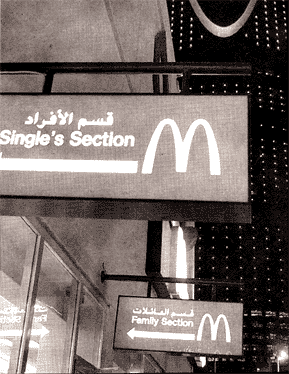
Sex-segregated McDonalds in Riyadh, Saudi Arabia. Women are confined to a separate "family section." New York Times, January 19, 2003.
ALLIES AND ENEMIES
US ALLIES
The Associated Press recently described Saudi Arabia as "a conservative kingdom that according to a strict interpretation of the Quran cuts off the hands of thieves and forces women to fully veil themselves in public."
--"Muslim rage flares as U.S. strikes Iraq" Associated Press, March 24, 2003.
"The Saudi religious police... use sticks to make sure women hide beneath their abayas, the long black cloaks. Women also have to use separate banks and schools and obtain written permission before traveling alone or going to a hospital. They must sit in the back seats of cars they are not allowed to drive."
Maureen Dowd, "Cleopatra and Osama," New York Times, Nov. 18, 2001, p. wk 13.
"In a three-hour Muslim cultural awareness class that is mandatory for all [US military] units at Ft. Dix... [The instructor] explained that Arab women have restrictions on behavior, dress and other personal displays. She then told them of a GI during the Persian Gulf War who had sex with a Muslim woman. 'He got shipped out of the country before anything bad could happen to him. She got beheaded,' Penner said."
"Gulf-bound troops get primer on Islam," Associated Press April 9, 2003
"Saudi Arabia has always had rigid segregation of men and women in universities and elsewhere in public life, with male faculty members teaching female students only through one-way video. In Oman, Sultan Qaboos University built separate corridors and entrances for men and women when its campus was being constructed in the late 1980's but students have generally refused to divide themselves."
--"Kuwaiti Universities Return to Separating Men and Women," Daniel del Castillo, Chronicle of Higher Education, 1-3-03, pp.A44-A46
In Kuwait, an Islamic-dominated parliament officially passed a bill in 1996 calling for the segregation of male and female students in higher education... The government gave Kuwait University five years "to develop existing buildings... to guarantee that male and female students do not mix... advocates of segregation also say that it improves the comfort level for women. "University students must talk and debate, but women are shy of speaking in front of men, and consequently they don't talk at all in class," said [a segregation advocate]. Many female students say that's nonsense. "What makes us shy is to grow up segregated from boys," says Khadija Ashkanani, a senior majoring in sociology. "When girls are segregated, their ideas are limited to what their families want, which is basically to have us stay home and produce babies."
--"Kuwaiti Universities Return to Separating Men and Women," Daniel del Castillo, Chronicle of Higher Education, 1-3-03, pp.A44-A46.
US ENEMIES
"If American ground troops are allowed to storm across the desert from Saudi Arabia into Iraq, then American servicewomen will theoretically not be able to drive vehicles as long as they are in Saudi Arabia and will be advised to wear an abaya over their heads. As soon as they cross the border into enemy Iraq, they'll feel as if they are entering the free world: they can legally drive, uncover their heads, and even call men idiots."
--Nicholas Kristof, New York Times, October 1, 2002 "Iraq's Little Secret."
"Saddam ran a brutal dictatorship. [but] centuries of vicious discrimination against girls and women was ended by one stroke of the modernizing dictator's pen. I used to drive past the Mustansariya University on my way home from downtown Baghdad. It was miraculous -- I use the word advisedly -- it was nothing short of miraculous to see hundreds of girl-students thronging the campus, none in "burkhas" or "chador" -- the head- to-toe black cape that was, and is, essential dress for women in most of the Islamic world -- and almost all in skirts and blouses that would grace a Western university. The liberation of women -- that is half the population of Iraq, as for any other country -- has been the most dramatic achievement of Saddam's regime. To understand how dramatic just look across the Iraqi border at America's once-favorite Arab satrap, Saudi Arabia."
--Mani Shankar Aiyar, Deputy Chief of Mission, Indian Embassy in Baghdad 1976-1978
Writing for United Press International, "India File: The Other Saddam" April 6, 2003.
"A man can stop a woman on the street in Baghdad and ask for directions without causing a scandal. Men and women can pray at the mosque together, go to restaurants together, swim together, court together or quarrel together. Girls compete in after-school sports almost as often as boys, and Iraqi television broadcasts women's sports as well as men's. 'No one thinks that sports are just for men,' said Nadia Yasser, the captain of the Iraqi women's soccer team, 'It's true that my mother was a bit concerned at first when I took up soccer, but I insisted, and so she accepted it and just started praying for me.'"
"More broadly, in a region where women are treated as doormats, Iraq offers an example of how an Arab country can adhere to Islam and yet provide women with opportunities. 'I look at women in Saudi Arabia, and I feel sorry for them,' said Thuha Farhook, a young woman doctor in Basra. 'They can't learn. They can't improve themselves.' At the Basra Maternity and Pediatrics Teaching Hospital, 25 of the 26 students in ob-gyn are women. Across town, 54 percent of Basra University's students are female."
--Nicholas Kristof, New York Times October 1, 2002 "Iraq's Little Secret."
Confusing al Qaeda and Iraq:
Are all Arabs alike?
The contention that Iraqi women suffer under Taliban or Saudi-like conditions has been fed by barrage of assertions that there is a connection between Osama bin Laden and Saddam Hussein. A New York Times/CBS poll in February 2003 showed that 42 percent of people in the U.S. thought that Saddam Hussein was involved in the September 11 attacks, something the Bush administration has never supported with evidence.
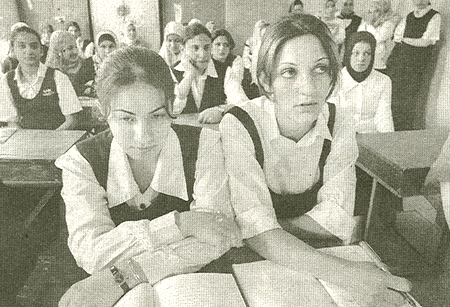
Iraqi students wait for the start of class at the Eastern Secondary School in Baghdad on May 4, 2003. (This picture accompanied an article entitled "Iraqi women wary of push for Islamic rule," The Gainesville Sun, May 7, 2003.)
"Saudi Prince Turki bin Faisal, his country's former intelligence chief, noted that bin Laden views Saddam Hussein "as an apostate, an infidel, or someone who is not worthy of being a fellow Muslim" and that bin Laden had offered in 1990 to raise
an army of thousands of mujaheddin fighters to liberate Kuwait from Iraqi occupation." Steven Zunes, "Seven Fallacies of U.S. plans to Invade Iraq," August 2002 Foreign Policy in Focus policy report.
Many argue that the two are actually enemies. "Saddam's Baath party is just the sort of secular Arab government that the ultra-religious al Qaeda organization would be likely to oppose" noted the Associated Press on January 30, 2003. "Bin Laden's beliefs sprung from the deeply conservative Wahhabi movement, which rejects smoking, drinking, and socializing between men and women... "Bin Laden and his men considered Saddam the killer of hundreds of Islamic militants," Gen. Hamid Gul, the former chief of Pakistan's spy agency, ISI, told the Associated Press. Associated Press, January 20, 2003.
"[U.S. Secretary of State Colin] Powell [contends] that bin Laden's recent audiotape, in which he exhorted his followers to acts of terrorism if the U.S. invades Iraq, proves a clear link between Saddam and al-Qaeda. That argument is laughable," writes Cynthia Tucker of the Atlanta Journal-Constitution. "In the audiotape, the religious fanatic Osama does not attempt to conceal his contempt for the womanizing, secular Saddam." "Powell squanders credibility by linking Osama to Saddam", Cynthia Tucker, February 25, 2003, Gainesville (FL) Sun.
"In a Qaeda house in Kabul [Afghanistan], there was a public statement from the 'Islamic Battalion, Kurdistan, Iraq,' dated Nov. 20, 1999, calling on 'the movement for Islamic unity' to help the jihad against President Saddam Hussein." New York Times, March 17, 2002, on documents found in Afghanistan after the U.S. invasion.
After the death and destruction of a US invasion, what now for women in Iraq?
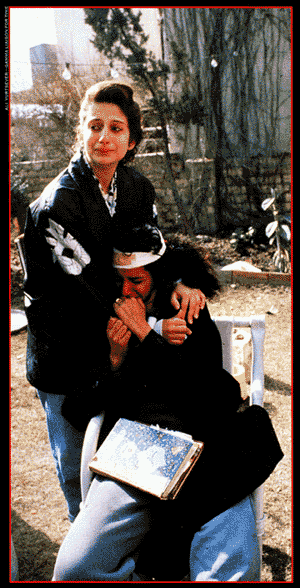
"As the administration plotted to overthrow Hussein's government, U.S. officials said this week, it failed to fully appreciate the force of Shiite aspirations and is now concerned that those sentiments could coalesce into a fundamentalist government..." Glenn Kessler and Dana Priest, "U.S. Planners Surprised by Strength of Iraqi Shiites," Washington Post,
April 23, 2003.
"They're saying, 'Now we've got our freedom we must make sure our women cover up.' Peter Ford of the Christian Science Monitor, reporting on a statement by Muslim clerics at a gathering in Baghdad, April 18, 2003 on National Public Radio's 'All Things Considered.'
"An art gallery owner I met, a woman with impeccable English, said that without Mr. Hussein, factions within the Kurds and Shiites would be at each others throats, and the fundamentalists would take over the government. She cited the modernization of roads, the economy and education, and the progress made by women under him. ... In 1995, Mr. Hussein held his first popular "referendum" and "won" more than 99 percent of the vote. Everybody abroad dismissed it, but my sense was that an honest poll would still have given him a victory--with 55 or 60 percent." Ethan Bronner, "To imagine Iraq after Saddam, you must think like an Iraqi" New York Times, April 4, 2003, p. A18.
"As the U.S. administration was reportedly considering a long-term military arrangement in the country, Senate Foreign Relations Committee Chairman Richard Lugar said the U.S. effort led by retired Gen. Jay Garner to begin rebuilding post-war Iraq has "started very late" and gaps were being filled by Shi'ite Muslims and others who seek a theocratic state over a democracy."
Tabassum Zakaria, "Senator: New Iraq Government Could Take Five Years" April 20, 2003, Reuters.
"KUT, Iraq, April 18 --"...Mr. [Sayed] Abbas, 52, was the first to arrive at city hall last week after Kut fell to the Americans. A Shiite Muslim preacher, he immediately declared himself the elected mayor of the city, though no election seems to have taken place. He has taken up residence amid the chandeliers, marble and mahogany of city hall and is surrounded by legions of zealous
supporters, an exclusively male population that grows larger by the day. Mr. Abbas is a local leader of the Supreme Council for the Islamic Revolution in Iraq, a political party that was outlawed under Saddam Hussein" Charlie Duff, "A Cleric Assumes a Bully Pulpit," New York Times, April 19, 2003.
"The fundamentalist groups use revolutionary slogans against the West but they have economic connections and interests in the West...they use many national liberation slogans, but they divide national unity by religion, sex, and creed." Nawal el Sadaawi,"Islamic Fundamentalism and Women," in North/South: The Nawal el Saadawi Reader Zed, London: 1997.
Iraqi women organizing under occupation

Women's Rights Activists from the Organization of Women's Freedom in Iraq participate in a demonstration by the Union of the Unemployed in Iraq. Baghdad July 29, 2003. Photo from German magazine Frankfurter Rundschau.
"Iraqi women have a long and valiant tradition of fighting for their rights. In 1958, 45,000 women demonstrated in the streets for their civil rights--a good decade before the modern American feminist movement was born." flyer of Defense of Iraqi Women's Rights asking support for the independent feminist newspaper Equality, based in Bahgdad, July 2003. Contact: shourash@msn.com or Khayal Ibrahim, 96 Deanscroft Square Sca, ON, MIE4W9, Canada
"We have seen how America attacked Iraq, destroyed its socio-economic infrastructure, and created a political vacuum, and we have seen how the Islamic fundamental groups have exploited the situation and are terrorizing women, forcing them to wear Hijab. More
than ever, we are hearing now that they throw acid on women's legs if they are walking in the streets without wearing socks, or if they are not wearing gloves in this burning summer, where the temperature reaches 45 degrees! [113 degrees Fahrenheit] ...
The USA brought back to force the most reactionary Islamic norms and values, which are highly discriminative against women, the USA has empowered them in the so-called Governing council..." Houzan Mahmoud, "The victims should be punished and the criminal is set free! This is the fair law of the 'liberators'" in Equal Rights Now! fortnightly paper of the Iraqi Women's Rights Coalition, August 1, 2003 iss. #5 equalrightsnow@hotmail.com.
"Conditions in Iraq were horrific. As they described it, things seem to be getting worse everyday. There is more than 60% unemployment, and those who work often do not get paid. Lack of safety and security is rampant. American soldiers are always ready to shoot.... According to the speakers, Iraqi people say the U.S. is causing these problems or that the U.S. just sits by and lets them occur so they can punish the Iraqi people, humiliate them, and break their will to refuse the US occupation...
"They also spoke about how women in Iraq are being kidnapped, raped, murdered, and victimized through "honor killings." They spoke about how Iraqi women are being forced to stay home, forced out of their jobs, and forced into wearing the veil. They said they met Yanar Mohamad and visited her organization and the women's shelter she is running. Her shelter has become a safe heaven for many women... They had a copy of the women's newspaper El Mosavaat (EQUALITY) and were very impressed with work of the organization." Mahmood Ketabchi, reporting on speech by Patricia Ackerman and Jodie Evans, two New York City activists, on a June trip to Iraq. They were part of a United for Peace and Justice and Global Exchange delegation to Baghdad. July 18, 2003.
Commenting on the Iraqi Ruling Council, and the tiny number of women appointed to it, Iraqi Women's Rights Coalition activists condemned the whole process:
"No-one has voted for these women to represent them, just as there have been no elections for the Iraqi people which have led to the establishment of the Iraqi Ruling Council...
"They have no interest in listening to what is happening to Iraqi people, in particular women. They do not what to know if women have been raped, abducted or killed and they will not raise questions about them. They do not want to have women's rights activists--struggling for freedom, equality, and an egalitarian society--to be included in their meetings or to voice the opinions of secular women and men that they are representing. They will therefore be prevented from exposing the realities of the suffering of Iraqi women at the hands of both US/UK soldiers and the Islamic groups. U.S. soldiers have started raping women in villages. ...
"There is hope, however. Iraqi people are becoming more organized and mobilising themselves. They are setting up workers' unions, unemployed unions and women's rights organisations. Many others are on the way to be established with thousands of members. These are the real people of Iraq-the grassroots majority which has been ignored. We hope that all people who believe in freedom will give their full support to the Iraqi people and back them in their struggle for a system of equality to be established in Iraq." Houzan Mahmoud, "The imposed Ruling Council on Iraqis has no legitimacy!" in Equal Rights Now! paper of the Iraqi Women's Rights Coalition, July 15, 2003, #4. equalrightsnow@hotmail.com.
Redstockings Comments on Corporate Media and Women in Gulf States During Gulf War, 1991
In 1991, with the U.S. bombing of Iraq underway, Redstockings assembled a photo exhibit in New York City to show that women in Iraq were much freer than their counterparts in neighboring Gulf states, U.S. allies such as Saudi Arabia, whose regimes receive massive U.S. military and political support.
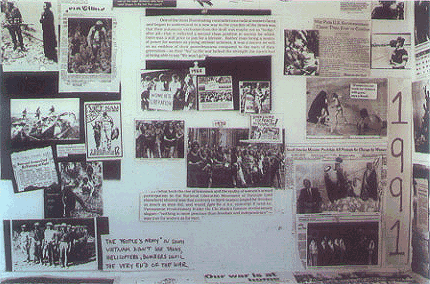
The "10 on 8" exhibit consisted of ten display windows on 8th Avenue, a collaboration of individual artists and groups responding to the Gulf War. In the Redstockings window, the photos of Iraqi women marching in the militia while women in Saudi Arabia wore burkahs at the beach were unfortunately a surprise to many of us, so propagandized are we by the corporate-owned media.
Still, the quotes and photos assembled there, like those here, are largely from corporate news sources, and they show that contradictory images do sneak through. If we're paying close attention, they can give us a glimpse of just how distorted the general picture is.
As the U.S. prepared to attack Iraq again, and is now occupying that country for the foreseeable future, we wanted to again show the achievements of Iraqi women, and destroy the myth that the U.S. is in any way liberating the women of Iraq by bombing, invading, and occupying their country.
We also know first-hand that the unelected George W. Bush has no interest in liberating women anywhere, because we are fighting his anti-woman policies here at home. In the interests of women's liberation, join us in opposing Bush's occupation of the White House and the U.S. occupation of Iraq.
"No sooner did Bush hit the White House, after the U.S. Supreme Court effectively installed him as president, than he began attacking women's rights, reinstating the 'global gag rule' [cutting off U.S. funding to international family planning organizations that disseminate information about abortion], yanking $34 million from the UN population fund, equating abortion with terrorism--the list goes on and on. NOW created a new campaign, "The Truth About George" to shine a spotlight on the damage Bush and his buddies are doing to our nation. The project's website, www.thetruthaboutgeorge.com, documents the whole picture of the Bush juggernaut and tells you what he's done … on the issues you care most about."
—National Organization for Women president Kim Gandy.
Some have argued that Saddam Hussein maintained what support he had from Iraqis because many saw his strongarm tactics as protection against a takeover by an even more despotic Islamic fundamentalism (see article by Mani Shankar Aiyar). The U.S. has long funded this kind of Islamic fundamentalism in the Middle East, sometimes openly, more often covertly. This is part of the evidence for what many contend are the real goals for U.S. power in the Middle East: to prevent the kind of independent progress and modernization required to make a country powerful enough to challenge U.S. and British corporate profit-taking and military control of the region's oil.
This would explain what otherwise seems to be a contradiction: that the U.S. has allied itself and financed the more reactionary, anti-women's rights regimes and mujahedeen movements such as the one that actually attacked the U.S., while targeting for destruction the more pro-women's rights governments and political movements in the region.
In keeping with this dangerous pattern-which is so contrary to the interests of women's liberation--it was the CIA which helped Saddam Hussein into power in Iraq, as an alternative to the more progressive, radical democrats and socialists in the Baath and other Iraqi parties.
Egyptian feminist Nawal el Saadawi wrote in 1990: "U.S. governments since Ronald Reagan have subscribed fully to the fundamentalist world view. ...Fundamentalists enjoy support throughout the U.S.A. Some groups own their own TV stations. They have a clear political agenda.... One of the major issues for fundamentalists now in the USA is the repeal of US laws legalizing abortion... fundamentalists-whether Christian, Jewish, Muslim or otherwise-are partners in the attempt to breed division, strife, racism and sexism; they help international imperialism to maintain its control and to overcome popular resistance to policies that lead to war and increased exploitation." ("Islamic Fundamentalism and Women," in North/South: The Nawal el Saadawi Reader Zed, London: 1997.)